
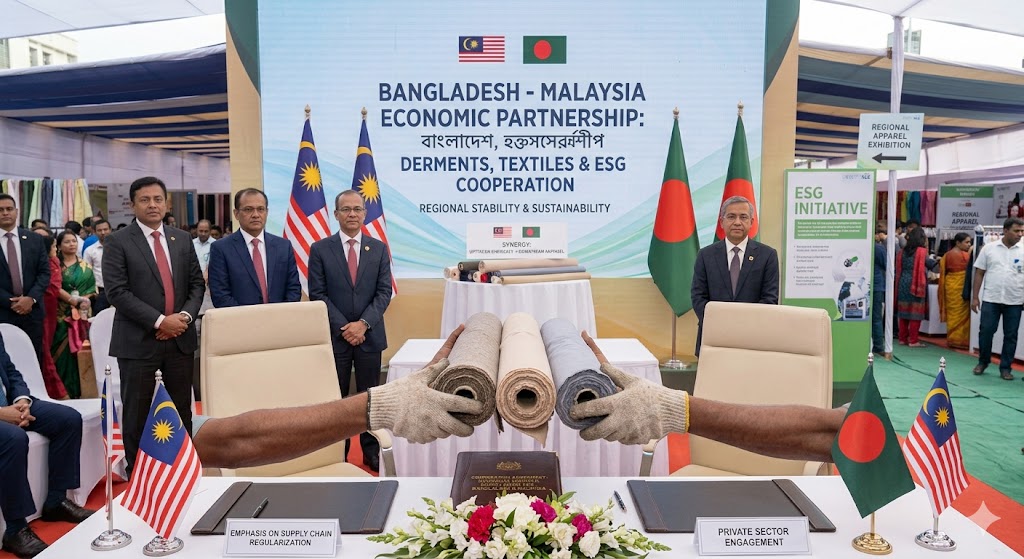
The global textile landscape is undergoing a massive structural realignment. Driven by escalating trade tensions, rising operational costs in traditional manufacturing hubs like China, and strictly enforced Environmental, Social, and Governance (ESG) mandates from Western buyers, international clothing brands are aggressively diversifying their supply chains.
In response to this tectonic shift, Bangladesh and Malaysia are proactively forging a deeper, highly complementary trade alliance. Rather than competing head-to-head for market share, both nations are leveraging an “eastward pivot” designed to turn geopolitical headwinds into economic resilience. This strategic alignment took center stage during Bangladesh Prime Minister Tarique Rahman’s recent official visit to Malaysia, where both nations committed to fast-tracking negotiations for a comprehensive Free Trade Agreement (FTA) aimed for completion by 2027.
By systematically fusing Malaysia’s high-tech upstream raw materials with Bangladesh’s downstream apparel manufacturing muscle, this evolving partnership is set to establish a highly competitive, green, and traceably secure supply hub for the global market.
Bangladesh High Commissioner to Malaysia Manjurul Karim Khan Chowdhury said the country remains a reliable sourcing partner, citing its competitive quality, cost efficiency and ability to meet regional buyer requirements.
“We have demonstrated competitive quality, cost-efficiency and readiness to meet the requirements of Malaysian and regional buyers,” he said at the Apparel & Textile Exhibition Malaysia (Atex Malaysia 2026) in Kuala Lumpur.
He said Bangladesh is confident these strengths will support stronger sourcing flows and encourage joint ventures through deeper supplier-buyer relationships between both countries.
He said the country is planning targeted buyer missions and business-to-business matchmaking initiatives and is open to supporting a proposed Bangladesh–Malaysia Textile Forum in Kuala Lumpur.
“At Atex 2026, we have identified strong business potential across ready-made garments, knitwear and apparel products,” he said in a statement.
The exhibition, held at the Malaysia International Trade and Exhibition Centre (MITEC) until June 27, comes as Malaysia positions itself as a regional hub for apparel sourcing and textile innovation amid shifting global supply chains.
According to the Malaysia External Trade Development Corporation (Matrade), Malaysia’s apparel and clothing accessories sector recorded total trade of RM18.24 billion in 2025, up 8.3 per cent year-on-year. Exports rose 6.2 per cent to RM6.88 billion, while shipments in January–May 2026 surged 27.8 per cent, reflecting stronger external demand.
Matrade deputy chief executive officer (export acceleration) S. Jai Shankar said global supply chain realignments are creating new opportunities for Malaysia as an alternative sourcing hub in Southeast Asia.
He said the local textile and apparel industry is also moving up the value chain through automation, sustainable production and higher-value design capabilities, supported by international partnerships and established domestic brands.
The exhibition featured 79 companies from Malaysia, Bangladesh, China, India, Indonesia and Japan, serving as a regional platform linking manufacturers, suppliers, buyers and technology providers across the textile value chain.
Jonoprosason/KA/26/06